When we think of medical emergencies, we often assume they happen to other people or in high-risk environments. But the truth is starkly different: a sudden cardiac arrest can happen to anyone, anywhere, and at any time.
It is a major public health issue across Australia. If a loved one, a colleague, or a stranger collapsed in front of you today, would you know how to respond? Understanding the reality of cardiac arrest and being trained in first aid isn't just a resume booster, it's a critical, life-saving responsibility.
The Reality of Cardiac Arrest in Australia
The numbers surrounding out-of-hospital cardiac arrest (OHCA) are confronting. According to the Aus-ROC 2024 report, there are 32,213 out-of-hospital cardiac arrests annually in Australia. That breaks down to a staggering average of 90 arrests every single day.
Perhaps the most sobering statistic is where these happen. The Heart Foundation reports that approximately 80% of these medical emergencies occur at home. This means that if you are ever called upon to perform CPR, the life you are trying to save will most likely belong to a family member or a close friend.
Currently, the overall survival rate is only about 1 in 10. But with community education and rapid response, we have the power to change that statistic dramatically.
The Life-Saving Power of Bystander CPR and AEDs
When a person goes into cardiac arrest, every single second counts. The Australian Productivity Commission's 2026 report emphasises that early recognition and rapid resuscitation are vital. Patients whose arrest is witnessed, and whose heart rhythm can be corrected with a shock, have significantly better immediate outcomes.
Here is the monumental difference your swift action can make:
- Double the survival rate: Simply stepping in to perform bystander CPR can double a person's chances of survival compared to receiving no immediate CPR.
- Up to 70% survival with an AED: If CPR is combined with the use of an Automated External Defibrillator (AED) within the first 3 to 5 minutes, survival rates can surge to around 60–70% in suitable circumstances.
We are already seeing the incredible impact of community readiness. In Victoria (2024–25), out of 7,550 patients attended by paramedics for OHCA, a massive 80% received bystander CPR before professional help arrived. Crucially, among those patients who were first shocked by a public AED, the survival rate to hospital discharge was an astonishing 63%.
Bystander intervention works. It saves lives.
Don't Wait for an Emergency to Wish You Were Trained
The gap between an ambulance being called and paramedics arriving is the most critical window in a cardiac arrest event. You are the bridge that keeps that person alive.
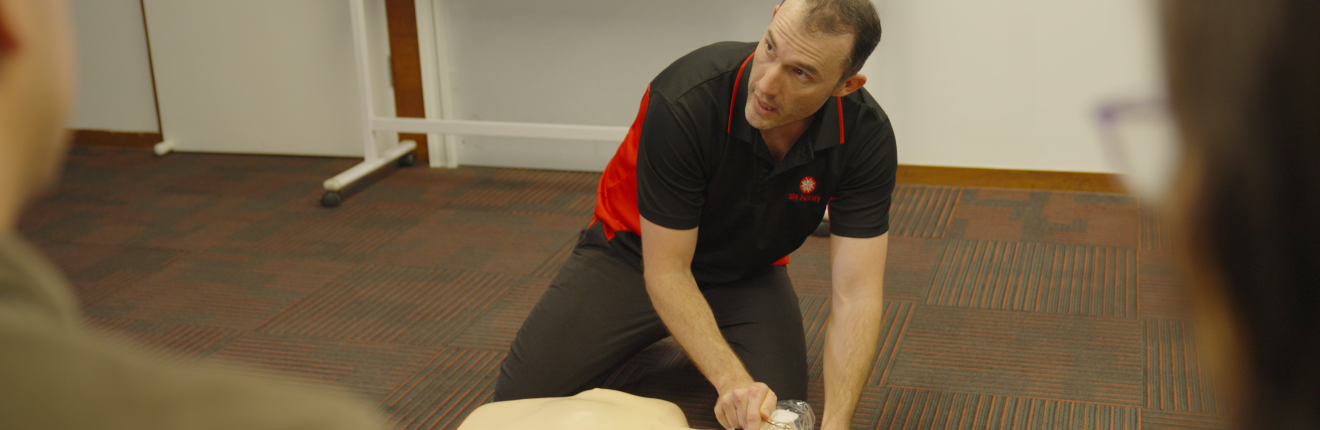
Gaining the confidence to jump in and help is easier than you think. Comprehensive training gives you the hands-on skills to recognise an emergency, perform effective chest compressions, confidently use a public AED, and calmly manage high-stress situations.
Are you ready to step up and become a lifesaver? Book your course today at St John QLD First Aid Training.
Find a St John QLD Training Venue Near You
We run comprehensive first aid and CPR courses at our dedicated St John training centres across the state. Find your nearest location below:
- Brisbane City: Suite 7, Level 8, 141 Queen Street, Brisbane QLD 4000
- Nundah: Unit 6/2 Jenner Street, Nundah QLD 4012
- Yeerongpilly: Unit 6b/88 Station Road, Yeerongpilly QLD 4105
- Caboolture: 5/3 Wharf St, Caboolture QLD 4510
- Gold Coast (Surfers Paradise): Suite G6 - 37 Bundall Road, Surfers Paradise
- Sunshine Coast: Elizabeth Daniels Way, Buderim QLD 4556
- Toowoomba: 5/12 Brook St, North Toowoomba QLD 4350
- Bundaberg: 19a Mulgrave Street, Bundaberg QLD 4670
- Maryborough: 130 Queen Street, Maryborough QLD 4650
- Mackay: 4 Leisure Court, Mackay QLD 4740
- Rockhampton: 2 Goodsall Street, Rockhampton QLD 4701
- Townsville: 36 Fleming Street, Aitkenvale QLD 4814
- Cairns: 40-42 MacNamara Street, Mununda QLD 4870